Showing posts with label sci fi. Show all posts

23.1.11

Tales of Tomorrow: Morrow on Mars

Tales of Tomorrow is an American anthology science fiction series that was performed and broadcast live on ABC from 1951 to 1953. At the same time as the television broadcast, it was also tried as a short-lived radio series by ABC running from January 1–April 9th 1953.


Tales of Tomorrow: "Morrow on Mars"
Show number 14
Story by ???
Radio broadcast: 1953-04-02

Apologies for the poor audio quality, not much has survived from this science fiction series.

Launch: Morrow on Mars

Thanks to wwwarchive.org for sharing these old time radio broadcasts.

17.1.11

X-minus One: "The Vital Factor"


"The Vital Factor"
Originally broadcast: November 30 1955


X Minus One - 55-11-30 X Minus One 027 The Vital Factor .mp3


Found at bee mp3 search engine

25.12.10

A Spacey Christmas to All


the holiday issue of Popular Electronics, 1958

13.2.10

X Minus 1: "The Trap"


"The Trap"
Originally aired February 13, 1957.

Thanks to Internet Archive for sharing these vintage recordings.

7.2.10

X Minus 1: "Sam This Is You"


"Sam This Is You"
Originally aired October 31, 1956.

Thanks to Internet Archive for sharing these vintage recordings.

1.2.10

X Minus 1: "Bad Medicine"

"Bad Medicine"
Original radio program aired July 10,1956.

Thanks to Internet Archive for sharing these vintage recordings.

29.1.10

X Minus 1: "How To"

"How To"
Original radio program aired April 3, 1956.

Thanks to Internet Archive for sharing these vintage recordings.

14.9.09

Special Interplanetary Issue


(The Mystery of Other Worlds Revealed, 1952)

6.8.09

Dynamic Science Fiction, Vol. 1, No. 4

illustration by Alex Shomberg
Dynamic Science Fiction
Vol. 1, No. 4
August 1953

24.2.09

Worlds of Fantasy

"Worlds of Fantasy"
Volume Number 8
Published by John Spencer & Co., London
1953
108 pages


1.1.09

Travelers of Space


From Travelers of Space
edited by Martin Greenberg
illustrations by Edd Cartier
published by Gnome Press, 1951
400 pages

Contents:
  1. Foreword, by Martin Greenberg
  2. Introduction, by Willy Ley
  3. "The Rocketeers Have Shaggy Ears", by Keith Bennett
  4. "Christmas Tree", by Christopher S. Youd
  5. "The Forgiveness of Tenchu Taen", by Frederic Arnold Kummer
  6. "Episode on Dhee Minor", by Harry Walton
  7. "The Shape of Things", by Ray Bradbury
  8. "Columbus Was a Dope", by Lyle Monroe (pseudonym for Robert A. Heinlein)
  9. "Attitude", by Hal Clement
  10. "The Ionian Cycle", by William Tenn
  11. "Trouble on Tantalus", by P. Schuyler Miller
  12. "Placet Is a Crazy Place", by Fredric Brown
  13. "Action on Azura", by Robertson Osborne
  14. "The Rull", by A. E. van Vogt
  15. "The Double Dyed Villains", by Poul Anderson
  16. "Bureau of Slick Tricks", by H. B. Fyfe
  17. "Life on Other Worlds", by Edd Cartier
  18. "The Interstellar Zoo", by David A. Kyle
  19. Science Fiction Dictionary


An anthology collection of science fiction short stories on the subject of intelligent life forms from interplanetary to intergalactic.
The stories originally appeared in the pulp magazines Planet Stories, Astounding, Thrilling Wonder Stories and Startling Stories.The high-light of this book are Edd Cartier's colorfully illustrated "Life on Other Worlds" section with an accompanying descriptive story by David Kyle, "The Interstellar Zoo."

12.12.08

A Warning and an Ultimatum


The Day the Earth Stood Still
Company:
20th Century Fox
Director:
Robert Wise
Year: 1951


Cast: Sam Jaffe, Michael Rennie, Patricia Neal, Hugh Marlowe, Billy Gray, Frances Bavier, Lock Martin, Elmer Davis, H.V. Kaltenborn, Drew Pearson, Gabriel Heatter

Plot:
A visitor from outer space lands his saucer in Washington, D.C. and announces to the people of Earth that they must live peacefully or faces the consequences as a threat to other planets.

The movie is based on a story by Harry Bates - “Farewell to the Master” which was originally published in the October 1940 issue of Astounding. You can read this in its entirety: Farewell to the Master.

Score: Bernard Hermann utilize the eerie and other-worldly theremin for the first time for the soundtrack of a screen production. You can hear a sample of this music here.


The Day the Earth Stood Still Desktop Wallpaper 1024 x 768


11.12.08

"They've Landed"


On January 4, 1954 the Lux Radio Theater presentated it's own transcribed adaptation of "The Day The Earth Stood Still." And as in the original 1951 movie, the part of the other-worldy main character, Klaatu, is played by Michael Rennie. The radio version stays faithful to the no-nonsense movie, seeming almost to be using the same shooting script, although be it slightly shortened for the alotted air time.

Thanks to nomig.net for providing this radio play for free downloading.

6.12.08

Spa-a-a-ce Patrol!

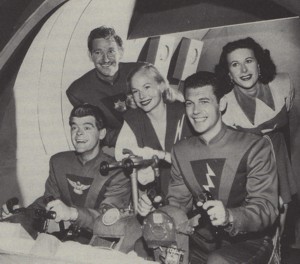
Space Patrol: an entertaining space adventure radio program primarilly aimed at kids, starring Buzz Cory and Cadet Happy. There was also a version which simultaneously aired on television.

Broadcast History: September 18, 1950 - March 19, 1955 (129 episodes) ABC, 30 minutes, Mondays and Fridays at 5:30 pm.

"This is Earth - the year 2100. New York is the headquarters of Space Patrol and men from Earth, Mars and Venus live and work there as guardians of peace. This is the story of those men, whose courage and daring make the universe safe for us all."

Space Patrol outlined the exploits of Commander Buzz Corey (Ed Kemmer), who was placed in charge of a thirtieth-century police-keeping force operating from a man-made planet known as Terra. The jurisdiction of the Patrol included Earth, Jupiter, Mars, Venus and Mercury, collectively known as the United Planets. Assisting Corey was his protégé Cadet Happy (Lyn Osborne), a youthful sidekick prone to uttering the exclamation “Smokin’ rockets!”

Space Patrol debuted as a series on television before also becoming a popular radio program. The show was one of a myriad of kiddy adventures that dotted television’s landscape back in the 1950s, along with its outer space brethren Captain Video and his Video Rangers, Rocky Jones, Space Ranger, and Tom Corbett, Space Cadet. It debuted as a fifteen-minute local show on KECA-TV in Los Angeles on March 9, 1950 and made its radio debut over ABC beginning September 18th as a twice-a-week (Mondays and Fridays) offering at 5:30 pm until January 8, 1951. It then returned to radio Saturday evenings at 7:00 pm beginning on August 18th before switching to a 10:30 am morning timeslot about a month later; remaining there until its final airing on March 19, 1955. The television version ended July 2 the previous year succombing to the trendy cowboy western.

Listen: Space Patrol Radio

The Past Through Tomorrow


The Past Through Tomorrow
by Robert A. Heinlein
A collection of his Future History stories

  • "Life-Line", 1939; a month before "Misfit"
  • "Misfit", 1939
  • "The Roads Must Roll", 1940
  • "Requiem", 1940
  • "'If This Goes On—'", 1940
  • "Coventry", 1940
  • "Blowups Happen", 1940
  • "Universe", 1941
  • "Methuselah's Children", 1941; extended and published as a novel, 1958
  • "Logic of Empire", 1941
  • "'—We Also Walk Dogs'", 1941
  • "Space Jockey", 1947
  • "'It's Great to Be Back!'", 1947
  • "The Green Hills of Earth", 1947
  • "Ordeal in Space", 1948
  • "The Long Watch", 1948
  • "Gentlemen, Be Seated!", 1948
  • "The Black Pits of Luna", 1948
  • "Delilah and the Space Rigger", 1949
  • "The Man Who Sold the Moon", 1950
  • "The Menace From Earth", 1957
  • "Searchlight", 1962

2.12.08

The Foundation Trilogy


The Foundation Trilogy
by Isaac Asimov
1951

Three classics of science fiction:
  • Foundation
  • Foundation and Empire
  • Second Foundation
"When the Galactic Empire began to die, when the ends of the Galaxy reverted to Barbarism and dropped away, Hari Seldon and his band of psychologists planted a colony—the Foundation—to incubate art, science, and technology, and form the nucleus of the Second Empire.

The course of the Foundation's growth was plotted according to the science of psychohistory—conditions were arranged to bring about a series of crises forcing it to move rapidly along the route to future Empire . . ."

Mr. Asimov

17.11.08

Of All Possible Worlds

Of All Possible Worlds
by William Tenn
1955
Contains the following Tenn classics:
  • Introduction: On the Fiction in Science Fiction
  • Down Among the Dead Men (Galaxy 1954)
  • Me, Myself and I (Planet, Winter 1947)
  • The Liberation of Earth (Future, May 1953)
  • Everybody Loves Irving Bommer (Fantastic Adventures, Aug 1951)
  • Flirgleflip (Fantastic Adventures, May 1950)
  • The Tenants (F&SF, 1954)
  • The Custodian (IF, Nov 1953)


William Tenn is the pseudonym for the science fiction work of Philip Klass. Born May 9, 1920, in London, England, he moved to New York where he grew up in Brooklyn. Since 1945, he has written academic articles, essays, two novels and more than 60 short stories.

The Science Fiction Encyclopedia ranked Tenn as "one of the genre's very few genuinely comic, genuinely incisive writers of short fiction."


Bibliography
  • Children of Wonder (1953)
  • Of All Possible Worlds (1955)
  • The Human Angle (1956)
  • Time in Advance (1958)
  • A Lamp for Medusa (novella published as a double with The Players of Hell by Dave Van Arnam) (1968)
  • Of Men and Monsters (1968) (novel)
  • Once Against the Law (1968) (anthology of crime fiction edited by Tenn and Donald E. Westlake)
  • The Seven Sexes (1968)
  • The Square Root of Man (1968)
  • The Wooden Star (1968)
  • Immodest Proposals: The Complete Science Fiction of William Tenn, Volume I (omnibus) (2000)
  • Here Comes Civilization: The Complete Science Fiction of William Tenn, Volume II (ominbus) (2001)
  • Dancing Naked, the Unexpurgated William Tenn (nonfiction omnibus) (2004) [Hugo Nominee, Best Related Book, 2005]

External Links:

16.11.08

Dimension X & X Minus One


Dimension X aired on NBC radio from 1950-51.

X Minus One
aired on NBC radio from 24 April 1955 until 9 January 1958 for a total of 124 episodes during its run.

X Minus One was an extension of Dimension X . The first fifteen scripts used for X Minus One were scripts used in the airing of Dimension X; however, it soon found its own little niche. The stories for the show came from two of the most popular science fiction magazines at the time; Astounding and Galaxy.

Dimension X was first heard on NBC April 8, 1950, and ran until September 29, 1951. This program was the first true series dedicated to the science fiction genre. Until the premiere of Dimension X -- a full two decades after network radio was established -- there were no major science fiction series of broad appeal to adults.

Special Thanks to OTRR and Internet Archive for offering these radio programs free for download to the public:
Related Posts Plugin for WordPress, Blogger...