Chesley Bonestell's concept painting of the space ark for the movie When Worlds Collide, from the Fawcett publication The Mystery of Other Worlds Revealed, 1952
It all began on June 24, 1947 when pilot Kenneth Arnold spotted some mysterious crescent-shaped lights skipping like saucers in the sky while he flew his small airplane. He reported seeing nine of the objects flying in a "V" formation over Mount Rainier, Washington (There was also a little known report in 1947 near a little town in New Mexico called Roswell). In the war years there were reports of "ghost rockets" and "foo fighters," but the tales never really caught public attention. This story however changed all that. The terms "flying saucer"and "flying disc" were adopted.
After reports of the Arnold sighting hit the media, other cases began to be reported in increasing numbers. By early July there was a sudden surge in sightings. Most American newspapers were filled with front-page stories of the new "flying saucers" or "flying discs" phenomenon.
In 1948 and 1949, strange green fireballs were seen exploding over the skies of New Mexico. Many feared they were guided missiles sent by the Soviet Union. The Air Force concluded that they were merely meteors.
1950 introduces the first flying saucer on celluloid, with the movie The Flying Saucer.
The Day the Earth Stood Still directed by Robert Wise, was released in 1951.
News stories and magazine articles pop up with topics such as "Some Saucers Still A Mystery," "Little Men Dressed In Blue," "Saucers And Mass Hysteria," and "Visitors From Outer Space?"
The United States Air Force, which coined the new term in 1952, initially defined UFOs as those objects that remain unidentified after scrutiny by expert investigators.
During the summer of 1952 Unidentified Flying Objects were seen roaming the skies over Washington D.C. and the White House.
George Adamski allegedly met an alien called Orthon in the California desert November 20, 1952. These friendly visitors warned of the dangers of scientific progress and gave a message for humanity.
In 1955 Fred Morrison sold his flying disc invention to WHAMO, which originally introduced it in 1957 as the "Pluto Platter". Three years later WHAMO rebranded the "Pluto Platter" as the "Frisbee."
In 1957 Brazil, farmer Antonio Villas Boas claimed a space woman captured and "had her way" with him.
Also in 1957 the Canadian aircraft builder AVRO (with considerable funding by the United States Air Force) rolls out its wingless saucer-shaped Y-2 Project, re-named the Avrocar.
In 1961, Betty and Barney Hill reported seeing a UFO following their car the night of September 19. Later, under hypnosis there was revealed a strange story of abduction.
By the end of the decade the saucer craze became an inseperable part of life in the Atomic Era America, and the rest of the globe for that matter: we ate flying saucer wafer candy, we lit our homes with flying saucer lighting, we watched them fly across the movie screen, we read the novelized stories in books, and we could play with an endless array of imaginative space toys. Disney turned them into amusement rides. Song writers composed about them. Architects even designed buildings to emulate them.
"british scientists are seriously engaged in a five-point program to develop a rocket that will carry men to the moon." from The Mystery of Other Worlds Revealed, 1952
"Realistically produced, with sound effects and accurate star positions, the planetarium's tour of outer space is both educational and prophetic." From The Mystery of Other Worlds Revealed, 1952
"The Mystery of Other Worlds Revealed" Fawcett Book Number 166 Author: Larry Eisinger (editor-in-chief) Publisher: Fawcett (Sterling Publishing Co.) NY 1952 magazine, 144 pages original price: $.75
Contents
Spaceships are Already Here!, by Harland Manchester
The Physical Problems of Space Travel Are Being Solved, by James L. H. Peck
A Journey to the Moon, by M. W. Wholey, G. I. Mech. E.
An Investigation of the Carolina Saucer, by John Duberry
Profusely illustrated with nearly 300 photos (B/W). Subjects include rocket development, space travel, life on other worlds, science fiction movies and flying saucers. Cover photo is from the movie When Worlds Collide (George Pal/Paramount Pictures).
Whether or not intelligent life may exist on other planets of our system, chances are it does throughout the universe.
The drawings here are by Edd Cartier, originally from the book, "Travelers of Space" published by Gnome Press, New York, and reprinted in "The Mystery of Other Worlds Revealed," published by Fawcett, 1952.
"on some unknown planet revolving about a distant sun, conditions conceivably could develop a being part insect, part bird."
(left) weird conception of artist here suggests combination of fish, mammal. (center) for this creature, artist used parts of octopus and carniverous plant. (right) an enviroment unlike that of earth might condition insect animals.
despite all these weird creatures imagined by well known science fiction illustrator edd cartier, the probability that intelligent life on other planets would have developed in a matter similar to our own
(left) a planet like jupiter, with poison gases in atmosphere, might sustain life like this. (right) silicon-cell insects on earth have been known to live indefinitely in kerosene.
"artist frank tinsley has this conception of life on jupiter: regardless of form, however, cell-content and structure develop from a limited set of favorable conditions. from The Mystery of Other Worlds Revealed, 1952


 George Adamski allegedly met an alien called Orthon in the California desert November 20, 1952. These friendly visitors warned of the dangers of scientific progress and gave a message for humanity.
 Also in 1957 the Canadian aircraft builder AVRO (with considerable funding by the United States Air Force) rolls out its wingless saucer-shaped Y-2 Project, re-named the Avrocar.

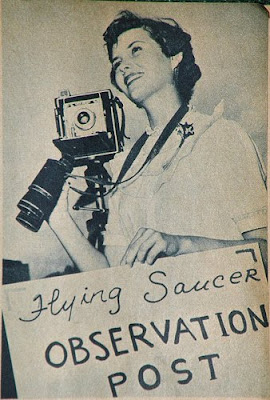 Mary Ellen Anderson is one of Texas students to organize saucer post


 The Great Zeiss Projector at Hayden Planetarium
 "here, a famous artist shows his idea of the equipment needed for moon exploration."
 "Realistically produced, with sound effects and accurate star positions,


 all paintings by Chesley Bonestell,
 "on some unknown planet revolving about a distant sun, conditions conceivably could develop a being part insect, part bird."
 (left) weird conception of artist here suggests combination of fish, mammal.
 despite all these weird creatures imagined by well known science fiction illustrator edd cartier, the probability that intelligent life on other planets would have developed in a matter similar to our own
 (left) a planet like jupiter, with poison gases in atmosphere, might sustain life like this.


